
Know what every trip made, before the lorry is back.
SWAY TMS runs a transport business end to end: the customer's order, the lorry receipt, the trip, the driver's expenses, the invoice and the money. Own lorries and hired ones, on the same file.
Built in India for transporters, fleet owners and freight forwarders running their own vehicles. Rate cards, lorry receipts, trips with advances and expenses, a driver app that works without a signal, GST invoicing for GTA, vehicle papers and maintenance, a customer portal, and profit worked out the same way on every screen.
Works Offline
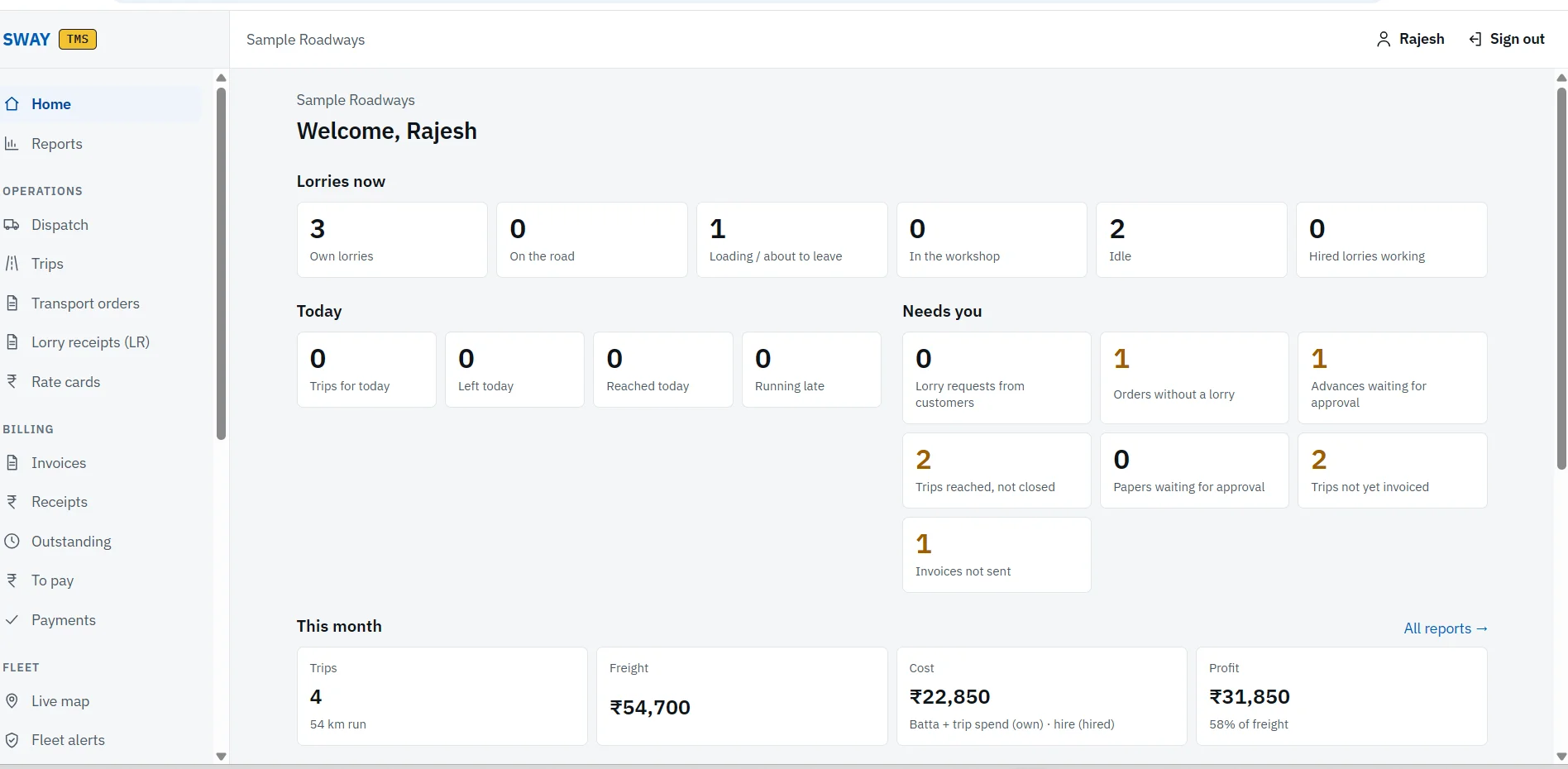
One workspace for a transport office and the lorries it runs.
A transport office runs on phone calls and a register. The rate agreed with the customer lives in someone's head, the lorry receipt is written by hand, the driver's advance is on a slip of paper, and diesel and toll are added up at the end of the month — by which time nobody can say whether a particular trip made money or lost it. SWAY TMS puts all of it on one file. The customer's rate is a rate card that has been approved. An order becomes a lorry receipt, and the lorry receipt becomes a trip on a named vehicle with a named driver. The driver carries the trip on their own phone: they move it along, photograph the diesel bill and the toll receipt, and capture the proof of delivery at the other end. Advances, expenses and hire land on the trip as they happen, so the trip's profit is known while the lorry is still on the road — not after the month closes.
Know your profit
Book and run the trip
The driver's phone
Fleet and workshop
Bill and settle
Customers and reports
Profit worked out one way, everywhere
On your own lorry a trip costs the driver's batta plus what was spent on the road. On a hired lorry it costs the hire, because its owner carries the running costs. That one rule is used on the trip screen, the dashboard and every report, so two screens can never quote you different margins on the same trip.
- Own lorry: batta + expenses
- Hired lorry: the hire
- One rule on every screen
Know your profit
On your own lorry a trip costs the driver's batta plus what was spent on the road. On a hired lorry it costs the hire, because its owner carries the running costs. That one rule is used on the trip screen, the dashboard and every report, so two screens can never quote you different margins on the same trip.
- Own lorry: batta + expenses
- Hired lorry: the hire
- One rule on every screen
Book and run the trip
The rate for a customer and a lane, approved before it can be used. Orders price themselves from it, so the figure on the invoice is the figure that was agreed.
- Approved before use
- Orders price themselves
A transport order becomes a lorry receipt, numbered and printed, carrying the consignor, consignee, goods and the freight terms.
- Numbered and printed
- Consignor and consignee
- Freight terms
Plan the trip, send it out, arrive, close it. Advances go through approval, expenses attach as they are spent, and the trip carries its own profit throughout.
- Advance approval
- Expenses as spent
- Profit on the trip
The driver's phone
Drivers sign in with a PIN — no email, no password to forget. They move the trip through its steps, log diesel, toll and other expenses with a photograph of the receipt, and capture the proof of delivery.
- PIN sign-in
- Receipt photographs
- Proof of delivery
The driver app installs on the phone like any other app. With no network, every tap and location is kept on the phone and sent in order when the signal returns, carrying the time it actually happened. The screen stays awake while a trip is live.
- Installs like an app
- Works offline
- Sent in order, with true timestamps
Fleet and workshop
Insurance, fitness, permit and PUC with their expiry dates, so what is about to run out is on the screen rather than remembered. Fuel and mileage per vehicle.
- Expiry dates
- Fuel and mileage
Bill and settle
Invoices in the modes a goods transport agency actually bills under — reverse charge at 5%, forward charge at 5% or 18%, or exempt — so the customer's accounts and yours agree about who pays the tax.
- Reverse charge at 5%
- Forward charge at 5% or 18%
- Exempt
Customers and reports
Your customers sign in at your own address to see their own shipments with the map and the proof of delivery, their bills, their statement — and to send you a lorry request your office accepts into an order or declines.
- Map and proof of delivery
- Bills and statement
- Lorry requests
Built for Businesses That
Keep Lorries Earning
SWAY TMS is transport management software built in India for transporters, fleet owners and forwarders running their own lorries. Rate cards price the order, the lorry receipt prints from it, and the trip runs on a named vehicle and driver — who carry it on their own phone, logging expenses with a photograph of each receipt and capturing the proof of delivery, with or without a signal. Advances, expenses and hire land on the trip as they happen, so profit is known before the lorry is back. Invoice in the right GST mode, record receipts with TDS, pay hire and settle drivers, and export to Tally. Customers track their own shipments, read their bills and ask for a lorry through their portal.

From the booking to the money, in four steps.
Every trip is booked, run, billed and settled in one workspace.
- 01
Set up your office and your fleet
Add branches, users and roles, then your customers, vehicles and drivers. Agree the rate cards, and have them approved.
- 02
Take the booking
Log the customer's order — or accept the request they sent from their portal. It prices itself from the rate card, and the lorry receipt prints from it.
- 03
Run the trip
Put it on your own lorry or a hired one, with a driver. They carry it on their phone: steps, expenses with a photograph of each receipt, and the proof of delivery. The customer can watch it on a tracking link.
- 04
Bill it and settle up
Invoice the customer in the right GST mode, record the receipt and its TDS, pay the lorry owner their hire and settle the driver. The trip's profit was known before any of it.
TRUSTED BY LEADING LOGISTICS COMPANIES



















Why teams choose it
Profit is known per trip, not per month.
Advances, diesel, toll and hire land on the trip as they happen, so the margin is visible while the lorry is still out.
- Per trip
- While the lorry is out
One rule for profit, on every screen.
Own lorry costs batta and expenses, hired lorry costs the hire. The trip page, the dashboard and the reports cannot disagree.
- Own lorry
- Hired lorry
- No disagreement
The driver's phone does the paperwork.
Expenses arrive with a photograph of the receipt and the proof of delivery arrives with the trip, instead of in a bundle at the end of the week.
- Receipt photographs
- Proof of delivery
No signal is not a problem.
Taps and locations wait on the phone and go up in order when the network returns, carrying the time they actually happened.
- Offline
- Sent in order
The rate on the invoice is the rate agreed.
Rate cards are approved before they can price an order.
- Approved rate cards
Customers stop telephoning.
Tracking, proof of delivery, bills and statements are in their portal, and so is the way they ask for a lorry.
- Tracking
- Bills and statements
- Lorry requests
What you need to get started
A modern browser
Chrome, Edge or Firefox, on a desktop or a phone.
- Chrome
- Edge
- Firefox
Your company address
Each company gets its own sign-in address. Your customers use the same address for their portal.
- Own sign-in address
- Customer portal
An Android or iPhone for each driver
The driver app installs from the browser — there is nothing to download from a store. Drivers sign in with a PIN.
- No app store
- PIN sign-in
User accounts
Created by your administrator, each with a role and a branch. Customer logins are handed out on the customer's own record.
- Role and branch
Your fleet and rates
Vehicles, drivers and the rate cards you have agreed with your customers.
- Vehicles
- Drivers
- Rate cards
Ready to Know Your Profit on Every Trip?
Transport management built in India: order to lorry receipt to invoice, profit on every trip.